Removing servers is only the beginning. Physical environment decommissioning requires organizations to unwind years of installed infrastructure while avoiding disruptions to building systems, neighboring tenants, and ongoing operations.
Introduction: Physical decommissioning
While IT asset decommissioning is the first step in vacating a space, it is rarely the last. Once the servers are gone and the racks are empty, organizations still face the task of removing the physical infrastructure that remains behind and returning the space to the condition required by their lease agreement.
At that point, the visible systems may be gone, but much of the underlying infrastructure remains. Cabling still runs through ceilings and risers. Wireless access points, AV systems, and conference room technology remain mounted in place. In many cases, those systems are intertwined with shared building pathways that were never designed to serve a single tenant alone.
Decommissioning, in other words, does not end when the servers leave. For many organizations, that is when the more consequential phase begins: unwinding years of installed infrastructure without disrupting neighboring tenants, building operations, or systems that remain in service.
The difference between an “empty space” and a “returned space”
Most commercial leases require tenants to return a space to something close to its original condition at the end of the lease term. On paper, that sounds simple enough. In practice, it often involves far more than organizations anticipate when they begin planning a move.
A space can look empty long before it is ready to be handed back. The desks may be gone, the servers removed, and the offices no longer occupied, but much of the infrastructure installed during the life of the tenancy is still there. Cabling remains above ceilings, under the floors, and inside walls; wireless access points stay mounted in place; and conference room displays, scheduling panels, and other integrated systems continue to occupy the space long after the equipment they supported has been removed.
These systems accumulate gradually. New cabling is added during expansions, equipment is relocated as teams grow, and technology deployments are layered onto existing infrastructure, year after year. By the time a lease ends, what began as a relatively simple installation has often become woven into the building itself.
That is why returning a space is rarely just a matter of equipment removal. Before anything can come out, teams need to understand what was installed, how it connects to the surrounding environment, and what can be removed without affecting systems beyond the tenant footprint. What appears on a floorplan as a clearly defined space often looks very different once technicians begin tracing pathways through ceilings, risers, and shared infrastructure.
Under the compressed timelines that often accompany a move, overlooked infrastructure has a way of making itself known.
The infrastructure left behind
The scope of physical environment decommissioning is often broader than organizations expect. Common categories include:
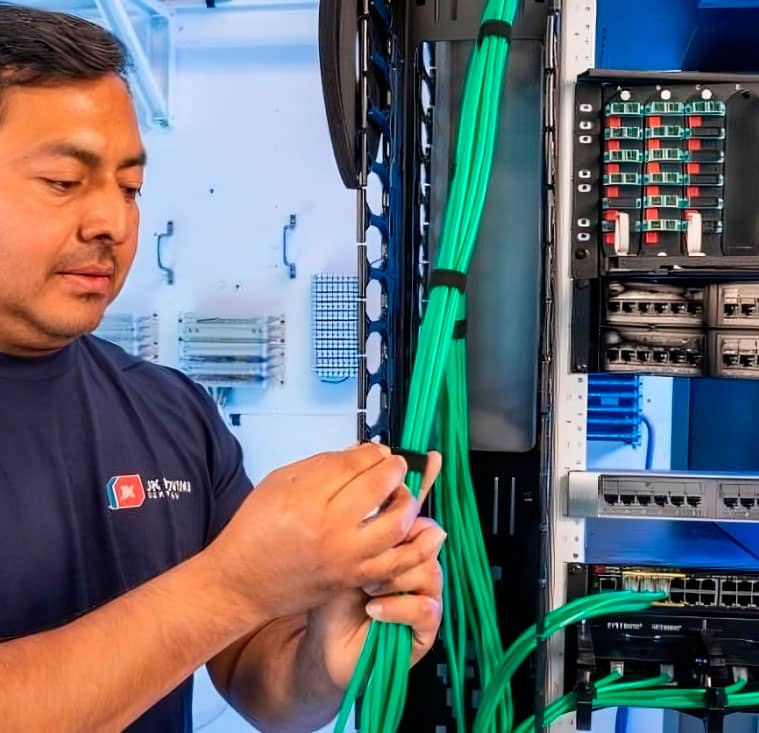
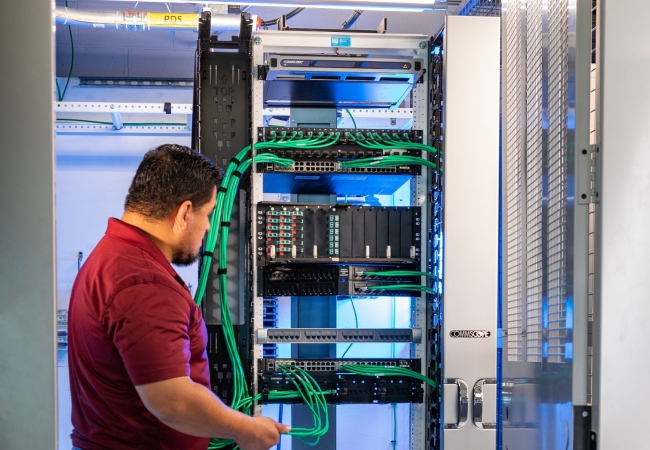
- Structured cabling: Copper, fiber, and hybrid cabling routed through ceilings, risers, shared pathways, and under floors. Removing it safely requires understanding how the network was built and where tenant cabling intersects with building infrastructure.
- Wireless infrastructure: Access points, controllers, antennas, and mounting hardware distributed throughout offices and common areas. Years of upgrades and reconfigurations can make it difficult to determine what is still active, what has been abandoned, and what belongs to whom.
- Conference room and AV systems: Displays, scheduling panels, microphones, speakers, cameras, and integrated conferencing equipment often mounted into walls, ceilings, and furniture as permanent fixtures.
- Network hardware and support infrastructure: Patch panels, racks, cabinets, cable management systems, and other components that support the broader technology environment and must be removed or dismantled as part of a complete closeout.
- Mounted and integrated devices: Sensors, cameras, monitoring equipment, and other wall- or ceiling-mounted technology that can be easy to overlook during planning but remains part of the tenant’s responsibility when returning the space.
Individually, none of these systems is particularly difficult to remove. The challenge lies in understanding how they connect to one another and what dependencies may exist beyond the immediate scope of the project.
The challenges of shared infrastructure
That challenge becomes more apparent in multi-tenant environments, where infrastructure rarely aligns neatly with tenancy boundaries.
Ceiling spaces, risers, and conduit pathways are often shared across occupants and may carry not only tenant cabling but also building systems that operate independently of any single organization. HVAC controls, fire safety systems, access control infrastructure, and monitoring systems may all run through or alongside the same pathways used for tenant-installed technology.
In practice, that means visual identification alone is rarely sufficient. Cables and trays that appear identical can serve very different functions depending on where they originate and what they support.
This is where risk concentrates. Removing or disconnecting the wrong component can affect adjacent tenants or building-wide systems that were never part of the intended scope of work.
In many cases, what may have initially been a clean installation with all cables well dressed, using consistent colors and well-marked labels, over time, becomes a veritable spaghetti bowl with large amounts of slack wrapped around and over existing infrastructure. This can make it very difficult to distinguish between what needs to be removed and what needs to remain. Often, an inexperienced team will just start “gripping and ripping”, and that can (and does) cause outages, which can be costly in both time and expense!
Across environments, the lesson is consistent: shared infrastructure does not reward assumptions. Success depends less on speed than on verification, sequencing, and a clear understanding of what belongs to the tenant and what does not.
Working in live or partially active environments
One of the challenges of decommissioning is that the infrastructure being removed often continues to support people and systems right up until the final stages of a move.
As a result, the work is not simply about identifying what needs to come out but determining when it can be removed and what dependencies need to be addressed first. Teams must understand what can safely be taken offline, what must remain in place, and how each phase of the work affects the systems around it.
When something behaves differently than expected, which is not uncommon in older or poorly documented environments, the ability to pause, assess the situation, and adjust without creating broader disruption becomes just as important as executing the original plan. In these conditions, experience shows up less as technical expertise than as sound judgment applied under changing circumstances.
Colocation as a parallel context
The same considerations apply in colocation facilities, where organizations are typically required to return cage space to its original condition at the end of a contract term.
That often means removing tenant-installed cabling, racks, mounting hardware, and other infrastructure introduced during occupancy. Organizations may choose to have the facility perform the work or engage a third party, but the underlying challenge remains the same: understanding what can be removed, what must remain in place, and how to complete the work without affecting neighboring customers or shared facility infrastructure.
While the environment may be different, the obligation remains much the same.
Sustainability and responsible disposal
What comes out of a space is only part of the equation. What happens to those materials afterward is increasingly part of a complete closeout strategy.
Copper cabling, metal infrastructure, and electronic components all have recycling value, and many organizations are paying closer attention to how those materials are recovered, reused, or disposed of at the end of a project. As sustainability commitments become more formalized, responsible handling is no longer an afterthought but an expected part of the process.
For organizations looking to reduce waste and maximize material recovery, decommissioning is not just about clearing a space. It is also an opportunity to ensure that valuable materials are diverted from the waste stream wherever possible.
Why experience matters
Physical environment decommissioning is not especially difficult because of any individual task. The challenge comes from the conditions in which those tasks are performed.
Shared infrastructure, incomplete documentation, active operations, and compressed timelines leave little room for assumptions. A cable that appears abandoned may still support a critical system. A pathway that seems isolated may serve infrastructure outside the tenant footprint. Understanding those distinctions is often more important than the removal work itself.
That is why experience matters. Not because the work requires rare expertise, but because it requires the judgment to know what can be removed, what must remain in place, and how to move through a space without creating problems elsewhere.
Physical decommissioning sits between facilities, IT, operations, and construction, often falling into the gaps between traditional responsibilities. Yet the consequences of getting it wrong belong to the organization vacating the space, which is why experience remains one of the most important factors in a successful closeout.