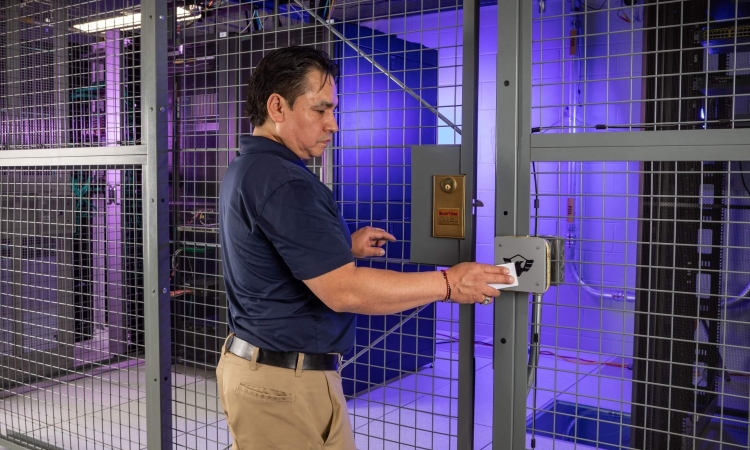
Data centers are the backbone of modern IT operations, supporting critical workloads across every conceivable private and public enterprise. Because they host these essential services, they also store sensitive and valuable information that must be managed, protected, and retired responsibly. While a data center’s physical structure can remain viable for decades, the IT infrastructure that it supports, including servers, storage, and networking hardware often reaches the end of its life much sooner. In many environments, major equipment refresh cycles occur every 5 years due to increased performance demands, hardware failure, and technological obsolescence.
As sustainability and operational longevity become priorities, operators increasingly rely on preventive maintenance, component upgrades, software updates, and continuous monitoring to extend equipment life. These strategies delay replacement and reduce waste, but ultimately, every system must be retired and disposed of responsibly.
Data center decommissioning is frequently seen as just another operational task, but it should actually be viewed as a separate vertical withing data center operations, where all aspects of IT decommissioning are considered holistically with considerable focus on risk mitigation. Improper handling of devices can compromise sensitive data, breach regulations, and leave an organization exposed to penalties, fines, legal liability, reputational damage, and failed audits. Decommissioning must therefore be treated as a controlled, evidence-driven process requiring detailed planning, disciplined chain-of-custody practices, and robust documentation that withstands regulatory scrutiny. Done correctly, it safeguards data, ensures compliance, and closes the operational lifecycle of infrastructure defensibly.
Disposal, sanitization, and destruction
Effective decommissioning starts with clear distinctions between disposal, sanitization, and destruction. These terms are often used interchangeably, but they represent different controls with different risk implications. Confusing them can lead to gaps in execution and documentation that won’t hold up under audit.
Disposal refers to the physical removal and final disposition of equipment, such as recycling, resale, return to a leasing provider, or landfill diversion. Disposal is primarily a logistics and environmental decision, but it becomes a security concern when devices contain storage media or embedded memory. On its own, disposal does not prove that data has been protected—it only describes where the asset ends up.
Sanitization is the process of removing data from media so it cannot be recovered. Methods vary by media type and data sensitivity, and many organizations rely on internal policies informed by core standards such as NIST SP 800-88to determine whether clearing (logical overwriting), purging (techniques that render data recovery infeasible), or destruction is appropriate. Sanitization is a data protection control, and its adequacy depends on the organization’s classification requirements and risk tolerance.
Destruction physically renders media permanently unusable through shredding, crushing, disintegration, or similar methods. It is often used when the highest assurance is required or when sanitization is not feasible. For instance, destruction is mandated for data centers that store private health data in accordance with HIPAA Security Rule 45 CFR§164.310. While destruction can provide strong confidence, it is not universally necessary and may introduce tradeoffs related to cost, logistics, and sustainability goals.
In a mature decommissioning program, these controls are applied intentionally and strategically. Hardware may be recycled only after sanitization is completed and documented, or storage components may be destroyed while other equipment is reused. The right approach depends on policy, data sensitivity, and the level of evidence and documentation needed to demonstrate control.
Chain of custody and positive control
Chain of custody is what keeps decommissioning accountable from start to finish. It’s the documented trail that shows where assets went as they moved from active use to staging, transport, processing, and final disposition. In other words, it answers the basic questions auditors and security teams always ask: what was handled, when, by whom, and where did it end up?
That ties directly to positive control, which is the ability to show that assets stayed under authorized oversight the entire time. Without documented positive control, even a well-run decommissioning effort can fall apart under review. If the paper trail doesn’t clearly show who had custody at each step, organizations may not be able to prove that assets were secured or handled according to policy even if nothing actually went wrong.
A strong chain of custody reduces risk because it keeps accountability intact at every stage, from collection through final disposition. It turns decommissioning from “we’re pretty sure this was handled correctly” into “here’s the record that shows it was.”
It also makes the process easier to manage operationally. When assets are logged and reconciled at each handoff, it’s much simpler to catch exceptions early, confirm completeness, and close out the project cleanly. In that sense, chain of custody isn’t just a security requirement, but one of the main tools organizations use to make decommissioning defensible and audit-ready.
Why decommissioning breaks down in real environments:
Most decommissioning failures aren’t caused by bad actors. They’re caused by everyday operational reality: rushed timelines, unclear ownership, incomplete inventories, and documentation that’s too thin to stand up later.
Decommissioning work often crosses teams and locations, and it’s easy for small gaps to creep in. In a data center decommissioning even a small custody gap, like a server being moved offsite, could create exposure by leaving the organization unable to verify that sensitive data was properly controlled or destroyed. What might not seem consequential in the moment can become a problem when an audit or security review happens months later and the organization has to reconstruct what happened from partial records. The solution to these issues becomes a more rigorous approach to operational procedure, documentation, and asset management.
Evidence tiers: What organizations can prove at closeout
Audit readiness in decommissioning comes down to evidence: what an organization can prove about asset handling, custody, and final disposition after the work is complete. Documentation is not an administrative byproduct; it is the mechanism that turns physical disposition into defensible risk management. While most decommissioning efforts generate paperwork, the rigor and usefulness of that evidence varies widely. Evidence tiers are not judgments about vendor quality but graduated levels of proof, each suited to different risk environments. The key question is not whether evidence exists, but whether it can withstand the level of scrutiny the organization may face from regulators, auditors, or internal stakeholders.
There is no universally “correct” tier of evidence—only what is appropriate given data sensitivity, regulatory exposure, internal policy requirements, and the consequences of failing to demonstrate control after the fact. Different asset classes may justify different levels of documentation within the same program, balancing operational efficiency with accountability. What matters is intentionality: selecting evidence levels that align with policy and risk tolerance, applying them consistently, and maintaining a clear, defensible audit trail that reduces friction and ensures outcomes can be verified long after decommissioning is complete.
To operationalize this approach, organizations can define clear evidence tiers that translate risk considerations into specific, actionable documentation standards:
Tier 1: Basic Certificates
At the most foundational level, decommissioning is often documented through a basic certificate of destruction or sanitization. These certificates typically attest that a defined set of assets was processed using a specified method within a given timeframe.
This level of evidence can be appropriate in lower-risk environments or for assets with limited data sensitivity. It provides confirmation that a process occurred, which may satisfy internal tracking or basic contractual requirements. However, certificates alone generally offer limited traceability. They rarely enable an organization to demonstrate how individual assets were tracked, reconciled, or controlled throughout the decommissioning lifecycle.
From an audit perspective, basic certificates establish intent and completion, but they leave gaps around accountability.
Some common certification includes:
Certificate of Destruction (CoD): Critical documentation showing that hard drives, SSDs, and tapes have been sanitized or physically destroyed (based on their asset risk level), documenting serial numbers, destruction methods, and dates. Certificates of Destruction are commonly issued by the party tasked with sanitization or destruction, whether that’s an internal IT or security team or a third-party IT Asset Disposition (ITAD) vendor.
NAID AAA: Ensures the decommissioning provider adheres to audited data destruction protocols.
R2 Responsible Recycling & e-Stewards: Certifies that electronic waste is handled, recycled, and disposed in accordance with environmental and safety standards.
ISO 14001 & ISO 9001: Ensures the provider manages environmental responsibilities as well as adheres to high-quality decommissioning practices.
NIST 800-88 Compliance: A standard for media sanitation that asserts that data is irrecoverable as it was disposed.
Tier 2: Inventory-Based Evidence
Inventory-based evidence strengthens the documentation by tying decommissioning outcomes to an asset list rather than a generalized statement. This typically includes intake inventories, asset counts, and reconciliation between what was collected and what was processed.
At this tier, organizations can demonstrate that assets were accounted for as a group, reducing ambiguity around loss or omission. Inventory-based evidence is often sufficient where policies require confirmation of completeness but do not mandate device-specific traceability.
While this approach improves accountability, it still operates at an aggregate level. If questions arise about a specific device, inventory-level documentation may not be sufficient to close the loop.
Tier 3: Serial-Level Evidence
Serial-level evidence provides device-specific traceability from collection through final disposition. Each asset is uniquely identified, tracked through custody transitions, and linked to a documented outcome.
This level of rigor is commonly required in regulated environments or organizations with mature information security and asset management programs. It applies to sensitive personal data, protected health information, financial data, or intellectual property and is often required for compliance with regulations like HIPAA, FACTA, and PCI DSS.
This level of evidence allows security, compliance, and legal stakeholders to answer precise questions: whether a specific drive, server, or endpoint was handled, how it was processed, and when disposition occurred. Serial-level documentation significantly reduces audit scope and investigative effort because it eliminates the need to infer outcomes from aggregated records. It also enables clearer internal accountability by aligning operational execution with formal asset registers.
Tier 4: Witnessed or Verified Destruction
The highest evidence tier is designed to provide irrefutable proof of destruction and involves direct verification of sanitization or destruction activities, either through internal witnessing, third-party observation, or other documented verification mechanisms. Destructions might include incineration, shredding, melting, or disintegrating hard drives and other materials. This approach is typically reserved for the most sensitive data classifications or environments with strict regulatory or contractual obligations and may include highly sensitive information that could breach national security, personal health information, and financial records.
Witnessed or verified destruction provides strong assurance that material is irretrievable, but it also introduces additional operational complexity. Scheduling, access controls, and documentation requirements increase, and costs can be significantly higher. As a result, this tier is not typical and is most effective when applied selectively based on risk.
On-site vs. off-site processing decisions
The choice between on-site and off-site processing reflects a tradeoff between operational impact, custody complexity, and evidence requirements. On-site processing allows organizations to maintain direct oversight of assets, minimizing transport risks and providing easier access for auditing or witnessed destruction. It can reduce the chance of custody gaps but may require dedicated space, equipment, and staff, which can disrupt normal operations. Off-site processing, often handled by specialized IT asset disposition (ITAD) vendors, can offer scalability, efficiency, and centralized expertise in destruction and documentation. However, it introduces additional custody touchpoints and requires careful verification that chain-of-custody procedures are followed during transport and processing. Ultimately, the decision should be guided by policy, data sensitivity, logistical constraints, and the level of evidence needed to satisfy auditors, regulators, or internal stakeholders.
Stakeholder-to-Evidence Mapping
Different stakeholders evaluate decommissioning success through different lenses, which is why evidence must be mapped to organizational concerns. For example:
- Security teams focus on whether sensitive data was protected and custody gaps were mininimized.
- Compliance teams look for documentation that satisfies regulatory and internal policy requirements.
- Operations teams care that the process ran smoothly, assets were tracked, and logistical issues were managed efficiently
- Legal or risk functions may require detailed serial-level records to address potential liability or future audits.
Mapping evidence to each stakeholder ensures the closeout package meets diverse expectations while maintaining a single, consistent record of accountability. This approach helps organizations demonstrate control, reduce exposure, and make audit and security reviews more straightforward.
What to Look for in an Audit-Ready Closeout Package:
An audit-ready closeout package can help simplify the decommissioning process for organizations by consolidating all documentation needed to demonstrate that decommissioning was completed according to internal policy and regulatory requirements. Proper records reduce the risk of failed audits, and provide clear, defensible evidence that sensitive equipment and data were handled securely and in compliance throughout the closeout process.
Typical components include:
- Asset inventories: Lists of all equipment decommissioned, often including serial numbers or tags.
- Chain-of-custody logs: Records of every handoff from collection to disposal.
- Certificates of destruction or sanitization: Proof that media were processed according to, but not limited to, NIST SP 800-88.
- Witness or verification records: Documentation of any observed or independently verified destruction activities
- Supporting materials: Optional items such as transport manifests, reconciliation reports, or photographs of destruction events.
By bringing these elements together, the package creates a single, defensible record that auditors, security teams, and regulators can review. It ensures accountability, confirms destruction, and provides organizations with verifiable evidence of decommissioning.