Artificial intelligence infrastructure has fundamentally altered the physical reality of networking.
The shift is often framed in terms of GPUs, fabric architectures, and throughput – but beneath those visible layers lies a less frequently discussed constraint: the Layer 1 physical infrastructure, including fiber trunks, cross-connect fields, patch panels, and structured cabling pathways that form the permanent link layer connecting compute, switching, and distribution areas.
Cabling density is increasing dramatically across main distribution areas (MDAs), horizontal distribution areas (HDAs), and equipment distribution areas (EDAs), which means installation precision matters more than ever.
Small mistakes at the physical layer – whether bend radius violations in fiber trunks, mislabeled patch panel ports, or undocumented cross-connect changes – can ripple upward into costly outages, because the network’s operational reliability depends as much on execution discipline at Layer 1 as it does on engineering design at Layers 2 and 3.
In traditional enterprise environments, structured cabling architectures separated permanent infrastructure – backbone fiber trunks, horizontal cabling, and cross-connect enclosures – from the movable patch layer, allowing equipment connections to change without disturbing the underlying cabling plant.
But AI clusters operate differently.
Higher port densities, increased fiber strand counts, and accelerated change velocity create operational environments where the survivability of the permanent link infrastructure – and the integrity of its documentation – often defines success more than raw bandwidth.
The difference between a stable deployment and a fragile one frequently comes down to whether Layer 1 was implemented with traceability between physical cable identifiers, patch panel ports, and documentation, ensuring that cross-connect relationships remain verifiable even as hardware configurations and port assignments evolve.
It’s a perspective reflecting a reality operators know well: what fails during change windows is rarely the switching fabric or logical topology, but rather labeling drift at cross-connect points, documentation mismatches between as-built diagrams and physical patch fields, or handling errors that compromise fiber integrity or traceability.
AI changes the physical reality of networking
AI infrastructure imposes demands that exceed traditional structured cabling assumptions. GPU clusters connected through high-speed leaf-spine or fabric architectures require massive parallel connectivity, often increasing backbone fiber counts between distribution areas by an order of magnitude compared with conventional enterprise deployments.
As Mark Ujczo, director of technology services at JK Technology Services explains, the physical infrastructure challenge begins with throughput requirements themselves.
“With AI there is a tremendous amount of throughput required,” Ujczo said. “Traditional Cat 5 and Cat 6 cables and traditional fiber are just not sufficient.”
Higher throughput requirements are addressed through parallel optical connectivity – using multi-strand fiber trunks terminated into high-density fiber switches and compute nodes.
However, even advances in optical transceivers and connector density cannot eliminate the physical constraints governing signal transmission.
“A piece of glass can only transmit so much data,” Ujczo said.
As a result, increasing throughput often requires multiplying the number of parallel permanent links and cross-connect pathways rather than relying on a single higher-capacity transmission medium.
“In older data centers, you might have a few dozen large fiber cables. Now you’re looking at several hundred,” he says.
This surge in trunk fiber density transforms both installation methodology and operational complexity. Each additional fiber trunk increases patch panel density, cable tray fill ratios, and cross-connect management overhead.
Permanent link infrastructure must remain stable while patch cords connecting switches and servers at the equipment distribution layer change frequently to support evolving workloads.
The result is not just more infrastructure, but a more complex and tightly coupled Layer 1 environment, where physical organization and administrative discipline determine whether infrastructure remains operable as density increases.
Throughput is necessary, but operability determines success
Network engineering conversations often focus on throughput and latency. Those metrics are essential, but they are not what typically causes outages in production environments.
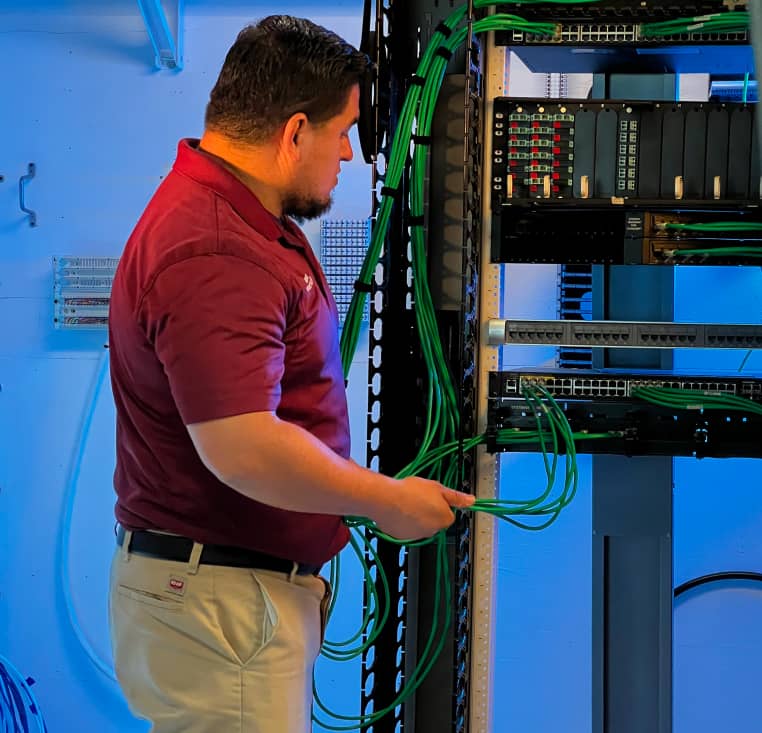
Instead, failures during maintenance windows frequently stem from operational issues at the physical layer: mispatching at cross-connect fields, ambiguous port labeling at patch panels, undocumented re-routing of patch cords, or incomplete test traceability linking physical cable identifiers to certification results.
AI environments magnify these risks because increased density compresses physical working space within racks and cable pathways. Patch panels serving hundreds or thousands of connections must remain accessible and intelligible under operational conditions, even as technicians perform adds, moves, and changes.
Ujczo emphasizes that even the physical act of installing permanent link infrastructure introduces risks that can compromise long-term operability.
“With 1,000-plus-foot runs, where you’re negotiating corners and other complications, you must identify all the pinch points,” he says. “One crimp in the cable and you’ve likely got to start over again, which could mean tens of thousands of dollars’ worth of materials and labor wasted.”
Fiber trunks, particularly those serving backbone connectivity between distribution areas, are subject to strict bend radius constraints. Exceeding these limits during installation or maintenance can introduce signal attenuation or latent failures that surface later during production use.
Connector handling presents another critical risk factor.
“Everything comes pre-terminated these days,” Ujczo says. “You’ve got to make sure that as you’re pulling it, you’ve got the proper protections in place and you’re pulling the actual cable casing, so you minimize the stress.”
Maintaining connector integrity ensures permanent links remain reliable and prevents degradation that could complicate future changes or troubleshooting.
Volume, density, and the mechanics of physical deployment
The sheer number of fiber trunks and permanent link pathways required in AI environments fundamentally alters installation methodology. Traditional one-at-a-time cable pulling is impractical when deploying hundreds of high-strand-count trunks across multiple distribution areas.
“You don’t want to pull cables individually–you’d be there forever,” Ujczo says. “You have to pull them in bundles in order to be efficient.”
This introduces additional Layer 1 constraints, including cable tray load capacity, twist prevention, and pathway conveyance management.
Improper handling during installation can introduce hidden defects, obscure cable identification, or create routing congestion that complicates future maintenance activities.
Physical conveyance infrastructure must also be scaled appropriately to accommodate trunk density.
“We used to use 12-inch wide cable trays,” Ujczo says. “Now it’s standard to have 30-36 inch double stacked trays to accommodate the volume.”
Cable trays and conduits supporting backbone infrastructure must accommodate both current and future trunk volumes while maintaining physical access to patch panels and cross-connect enclosures.
These structural adjustments ensure conveyance systems can safely support increased cable weight and density while preserving serviceability and long-term maintainability.
The hidden risk: Administrative debt at Layer 1
Beyond physical installation challenges lies administrative debt – the gradual divergence between documented cabling topology and physical reality.
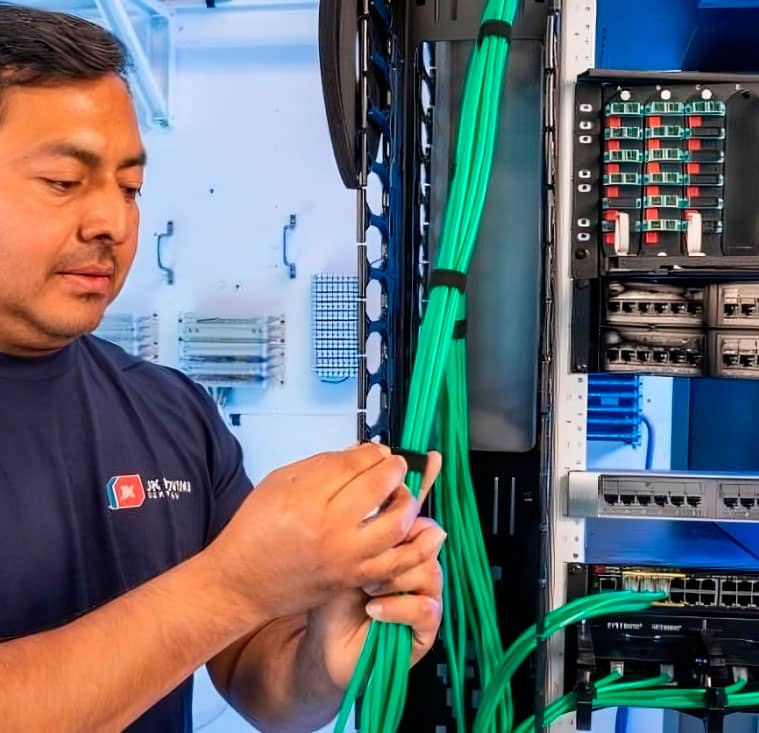
Structured cabling architectures depend on stable permanent links and accurately administered patch fields to preserve operational clarity. When documentation no longer reflects physical connections, the structured architecture loses its operational value.
Planning and documentation discipline are essential to preventing this erosion.
“Planning is the key to anything,” Ujczo says. “It’s a lot easier to get a small team together to plan everything out ahead of time.”
That’s why it is important to build in a translation layer between network architects and engineers who design infrastructure and the technicians responsible for implementing it in the field.
This ensures that physical installations match documented topology and remain traceable over time.
“It is important to have a specialist in place who can speak the language on both sides,” Ujczo says. “Think of it as the translation layer between the super technical folks who write these checklists and the people on the ground who actually have to do it.”
This alignment ensures permanent link infrastructure, patch panel administration, and documentation remain synchronized as infrastructure evolves.
Designing Layer 1 for change control
AI infrastructure environments are defined by continuous change. Hardware refreshes, cluster expansion, and fabric reconfiguration require frequent patching changes at cross-connect points while permanent backbone infrastructure remains in place.
Futureproofing ensures permanent link infrastructure supports these changes without requiring disruptive reinstallation.
“You’re setting the client up for success down the road,” Ujczo says.
Planning trunk pathways, conduit capacity, and patch panel availability ahead of demand ensures infrastructure can scale without compromising traceability or accessibility.
Hyperscale operators often define highly detailed installation specifications governing trunk routing, patch panel administration, and documentation requirements.
“They don’t just tell you what they want,” Ujczo says. “They tell you exactly how they want it, because their processes and checklists tend to be pretty complex.”
Execution requires translating these specifications into physical installations that remain maintainable in real operational conditions.
“You have to balance between the theoretical and the reality of the world,” he says.
Illustrative scenario: How administrative debt consumes a change window
Consider a GPU cluster undergoing a planned refresh. The permanent link infrastructure between distribution areas remains intact, but patch panel labeling and port mapping documentation have not been consistently updated.
Technicians must trace connections manually through high-density patch fields, verifying trunk connections and cross-connect relationships. Cable congestion obscures identifiers. Patch cords block access to panel ports.
What should have been a routine patching operation becomes a prolonged troubleshooting exercise.
The root cause was not bandwidth limitations or switching architecture. It was the breakdown of Layer 1 administrative discipline.
Validation, documentation, and operational readiness
Operational readiness requires maintaining complete traceability between permanent links, patch panel connections, and documentation artifacts.
Critical documentation includes:
- As-built topology diagrams
- Port-to-panel mapping records
- Cable identifiers linked to physical trunks
- Certification and test result records
- Change logs reflecting physical modifications
Validation checkpoints – including pre-change verification and post-change confirmation – ensure Layer 1 topology remains synchronized with documentation. These practices preserve the operational integrity of structured cabling infrastructure and enable safe, efficient change execution.
Labeling and administration discipline
Consistent, precise labeling enables faster identification and reduces the risk of mispatches. Labels should identify ports, panels, cable endpoints and intermediate distribution points in a way that matches how documentation records are structured.
Color-coding and durable labeling materials help ensure that markings remain legible over time and through environmental stressors. Effective labeling schemes are part of structured cabling standards such as ISO/IEC 11801, which define conventions for identifying cable pathways and connections.
Labeling must extend beyond patch panels to include fiber trunk bundles, terminal blocks and any branch points. Without a systematic approach, teams can inadvertently create their own local conventions that conflict with each other, leading to confusion during maintenance or staff turnover.
Execution discipline is the foundation of AI infrastructure reliability
AI infrastructure demands extraordinary throughput – but throughput alone does not ensure operational success.
Structured cabling architectures provide the permanent link framework, but operational discipline ensures those structures remain usable as density and change velocity increase. Physical installation quality, patch panel administration, labeling discipline, and documentation accuracy ultimately determine whether infrastructure remains resilient over time.
As Ujczo notes, in AI-era environments, Layer 1 is no longer just the foundation of connectivity – it is the foundation of operational resilience.